AgileHero is live!
AgileHero is live. From today, anyone can sign up with an email address or with Google. A working workspace, project, and board exist the moment you do, and there's nothing to set up.
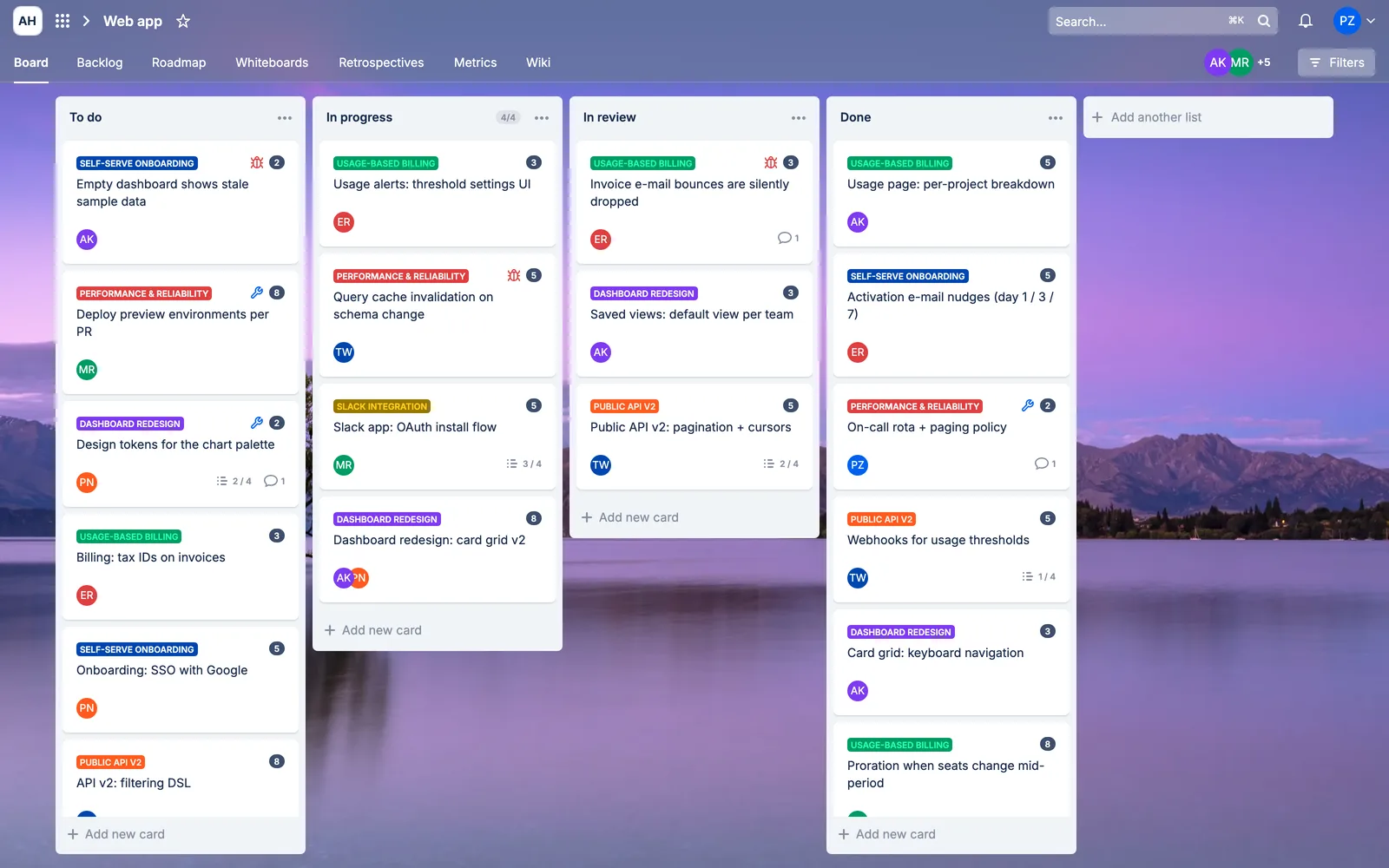
The modules on day one:
- Boards: a kanban board with a backlog, and as many lists as your flow needs. Nothing is in the way, so the board shows where everything stands at a glance. A list can carry a card limit to keep work in progress under control, and it never blocks anyone.
- Cards and epics: living documents with rich text, inline images, files, video, named checklists with progress bars, and @mentions. Epics group cards into initiatives, with live progress by stage.
- Roadmap: a drag-and-drop timeline with weekly and quarterly zoom, viewed by initiative or by each person's capacity.
- Whiteboard: infinite, with sticky notes, shapes, mind maps, arrows, and live cursors. One click turns a whole mind map into an epic with cards and labels.
- Wiki: nested rich pages, discussions pinned to the exact passage, and full version history.
- Retrospectives: a retro board with six fixed columns, a timer, thumbs-up voting, and a link to the previous retro.
- Metrics: velocity and cumulative-flow charts that build themselves from board movement, with no manual data entry.
Next to the modules, the MCP server: AI assistants work in AgileHero over the Model Context Protocol (MCP). They create, estimate, organize, move, and comment on cards and epics. They can only ever do what you can do.
Every change appears live for the whole team, on boards, cards, epics, the roadmap, the wiki, and the whiteboard. The roadmap, the whiteboard, the wiki, retrospectives, and metrics are Pro modules.
Also on the board: estimation poker on the card, with hidden votes, an instant reveal with the minimum, maximum, and average, and one-click apply.